

Iran Exploration Tour: Tehran, Masuleh, Alamut, Kashan, Mesr, Yazd, Persepolis, Shiraz, Koohrang, Isfahan

Day 1 – Arrival in Tehran
Welcome to Tehran, the vibrant capital of Iran! Upon your arrival at Tehran International Airport, you will be met by our friendly representative, who will assist you with all airport formalities and escort you to your hotel for check-in.
Depending on your arrival time, you can relax after your flight or take a short stroll in the city to get your first glimpse of modern Tehran — a dynamic metropolis that beautifully blends ancient Persian heritage with a contemporary lifestyle.
Enjoy your first evening in Iran and prepare for the incredible cultural journey that lies ahead.


Day 2 – Explore Tehran: The Beating Heart of Iran
Your first full day in Tehran, the capital of Iran and the largest metropolitan city in the Middle East, begins with discovery and contrasts. Tehran is a city that never sleeps — a fascinating blend of ancient tradition and modern innovation, where old-world charm meets urban sophistication.
This vibrant capital has played a central role in Iran’s modern history, and one day is barely enough to experience its diverse layers. From royal palaces and bazaars to museums, mountain views, and trendy cafés, Tehran has something for everyone.
Morning – A Journey Through History
Start your day with a visit to the National Museum of Iran, which offers two major exhibitions:
-
The Museum of Ancient Iran, showcasing prehistoric and ancient artifacts.
-
The Museum of Islamic Art and Architecture, highlighting masterpieces from Iran’s Islamic eras.
This visit gives you an excellent overview of the country’s rich history — a perfect introduction before traveling through Iran.
Next, explore the Golestan Palace, one of Tehran’s oldest and most beautiful historical sites. Once the royal residence of the Qajar dynasty, this UNESCO-listed complex features 17 structures, including lavish halls, palaces, and museums adorned with exquisite tilework and mirrored interiors.
Afternoon – Treasures and Traditions
If time allows, visit the Treasury of National Jewels, an extraordinary collection of precious gemstones, royal crowns, and the legendary Peacock Throne — each piece with a fascinating story.
Continue your exploration at the Grand Bazaar of Tehran, a centuries-old marketplace divided into specialized corridors selling carpets, spices, gold, textiles, and handicrafts. It’s the perfect place to experience the city’s heartbeat and interact with locals.
Evening – Modern Tehran & Relaxation
To experience the modern face of Tehran, head to the northern part of the city. Take a stroll across the Nature Bridge (Pol-e Tabiat) — an architectural landmark connecting two major parks with scenic views of the skyline and the Alborz Mountains. End your day in one of the cozy cafés or rooftop restaurants nearby, watching the city lights come alive.

Day 3 – Tehran to Lahijan: From the Capital to the Caspian Coast
After breakfast, leave behind the bustling capital and head north toward the Caspian Sea, driving through the green valleys of the Alborz Mountains. The journey itself is a highlight — you’ll take the legendary Chalus Road, one of the most scenic mountain routes in Iran. Winding through dramatic landscapes, lush forests, and deep valleys, this drive offers breathtaking views at every turn.
As you descend from the mountains, the air grows cooler and the landscape transforms into a green paradise. The Caspian coast is one of the most fertile and verdant regions in Iran — a refreshing contrast to the country’s central deserts. It’s no wonder this region is a favorite getaway for locals seeking nature, tranquility, and sea breezes.
Your destination is Lahijan, a picturesque town nestled on the slopes of the Alborz Mountains and surrounded by endless tea plantations. Known as the tea capital of Iran, Lahijan offers the perfect introduction to northern Iran’s charm and hospitality.
Take a leisurely walk through the tea fields of Sheitan Kuh (Devil’s Mountain), where rows of vibrant green tea bushes stretch across the hills. Enjoy the panoramic view of the town and its lake below — a peaceful end to a scenic day’s journey.

Day 4 – Lahijan to Masuleh: From Tea Fields to the Misty Mountains
Today’s journey takes you from the rolling tea plantations of Lahijan along the scenic Caspian Sea coast toward the lush mountains of Gilan Province. You’ll pass through Bandar-e Anzali, one of Iran’s main port cities on the Caspian Sea, famous for its Anzali Lagoon — a haven for migratory birds, water lilies, and tranquil boat rides. If time allows, a short stop here offers a refreshing glimpse of local life by the water.
From the coast, your route winds upward into the green Alborz foothills toward Masuleh, one of Iran’s most enchanting mountain villages. Surrounded by thick forests and often wrapped in mist, Masuleh feels like a step back in time. This village, over a thousand years old, is unique for its terraced architecture — the roof of one house serves as the courtyard of the one above. With its narrow alleys, stepped lanes, and traditional clay-colored houses adorned with wooden balconies and flower pots, Masuleh is a true architectural and cultural gem.
Spend the afternoon wandering through the maze of alleys, visiting small local shops, and enjoying tea with a view of the mist-covered mountains. If you’re up for a bit more adventure, you can take an optional excursion to Rudkhan Fortress, a spectacular medieval stronghold hidden deep in the forest. The hike to the fortress is rewarding, with breathtaking views of the green valley below.
As evening falls, enjoy the calm atmosphere and cool mountain air — a perfect contrast to the warm Caspian coast you left behind.

Day 5 – Masuleh to Qazvin via Soltaniyeh: Crossing the Alborz to the Land of Empires
After breakfast, you leave the misty highlands of Masuleh and begin your scenic drive toward Qazvin, crossing the dramatic landscapes of the Alborz Mountains once again. The route takes you through winding roads, forested hills, and fertile valleys before reaching the drier plains of Zanjan Province, where a remarkable historical monument awaits — Soltaniyeh Dome.
Your stop in Soltaniyeh, a UNESCO World Heritage Site, is a highlight of the day. The Mausoleum of Oljaitu (Sultan Muhammad Khodabandeh), dating back to the 14th century, stands as one of the greatest achievements of Ilkhanid-era architecture. Its awe-inspiring turquoise dome, 49 meters high, is one of the largest brick domes in the world and a true masterpiece of Persian-Islamic engineering. Inside, delicate stucco work, intricate calligraphy, and geometric patterns reflect the artistic refinement of the Mongol period, when Soltaniyeh briefly served as the capital of Iran.
Continuing your journey, you reach Qazvin, a city known as the gateway to the Persian plateau and the first capital of the Safavid dynasty before Isfahan. Qazvin’s historical importance is reflected in its beautiful collection of monuments, mosques, and old caravanserais.
You will visit the ancient city gate (Darvazeh Tehran), the Jame Mosque, one of the oldest and largest in Iran with architectural elements from different eras, and the Shrine of Shazdeh Hossein, an important pilgrimage site known for its exquisite mirror work and lively atmosphere.
As evening falls, stroll through Qazvin’s traditional bazaar, where you can see artisans at work and enjoy a taste of local sweets such as Baghlava and Noghli.

Day 6 – Qazvin / Excursion to the Legendary Alamut Valley
Today you embark on an unforgettable journey into the heart of one of Iran’s most dramatic and mysterious regions — the Alamut Valley, located northeast of Qazvin in the foothills of the Alborz Mountains.
This isolated valley is deeply rooted in the legends of the Assassins, or Hashashin, a secretive sect that rose to power during the 11th century under the leadership of Hassan-i Sabbah. From their strongholds in the Alamut Mountains, they established a network of impregnable fortresses, the most famous being the Castle of Alamut, which still crowns a rugged peak overlooking the valley. Though largely in ruins today, the remains of this ancient fortress continue to evoke the power and mystery of its past, when it was considered unconquerable.
The drive to Alamut is as captivating as the history itself. You travel through a rugged mountain landscape with ochre-colored cliffs, winding roads, and lush green valleys dotted with small villages. Along the way, you can make scenic stops to enjoy panoramic views and experience the peaceful rhythm of rural life.
Upon reaching the Alamut Castle trailhead, a moderate hike takes you up the hill to the ruins, where breathtaking views of the surrounding valley await. The effort is well rewarded — standing on the ancient fortress walls, you can feel the echoes of centuries past and imagine the strategic vision of those who once ruled from this hidden citadel.
In the late afternoon, return to Qazvin, passing through the same scenic valleys and perhaps stopping at a local teahouse for a cup of Persian tea before arriving back at your hotel.

Day 7 – Qazvin → Kashan via Qom
After breakfast, you leave Qazvin behind and begin your journey south toward Kashan, one of Iran’s most charming desert cities. On your way, you may choose to stop in Qom, one of the holiest cities in Iran and a significant center of Shiite scholarship and theology.
Qom holds a special place in Iran’s spiritual landscape. It is home to the Shrine of Hazrat-e Masumeh, the sister of Imam Reza, and one of the most important pilgrimage sites for Shiite Muslims. Visiting this sacred complex offers a fascinating glimpse into the heart of Iran’s religious life.
As you approach the shrine, the golden dome gleams in the sun, drawing pilgrims from across Iran, Central Asia, and the Middle East. The atmosphere here is deeply spiritual — men and women dressed in traditional attire, the murmuring of prayers, and the flow of devotion all around you. Women wrapped in black chadors, clerics and theology students walking through the courtyards, and the sense of unity in faith create a truly powerful experience.
If time allows, you can take a short stroll around the city to experience its religious schools, traditional bazaars, and the distinctive rhythm of life in this holy city.
Continuing your journey, you reach Kashan in the evening — a serene oasis on the edge of the desert. You will stay in one of the beautifully restored historic houses that once belonged to Kashan’s wealthy merchants. These boutique hotels, with their peaceful courtyards, stained-glass windows, and fountains, perfectly capture the elegance and charm of traditional Persian architecture.

Day 8 – Kashan
Kashan, a small oasis town on the edge of the desert, is a true gem of Persian architecture and craftsmanship. The city’s wealthy merchants once built some of the most magnificent traditional houses in Iran — elegant mansions where every corner reflects artistry, taste, and refinement.
Many of these houses are located close to one another and not far from your boutique hotel. You can begin your day by visiting the Tabatabai House, a masterpiece of Persian residential architecture with its stained-glass windows, intricate stucco work, and peaceful courtyards. Then continue to the Borujerdi House, built for a merchant known as “Mr. Samovar,” where the frescoes painted by the celebrated artist Kamal al-Molk bring the walls to life with beauty and history.
Nearby lies the Hammam-e Sultan Amir Ahmad, a traditional Persian bathhouse and one of the finest examples of its kind in Iran. Though no longer functioning as a bath, its beautifully tiled domes, vaulted ceilings, and multi-room layout offer a glimpse into the elegance of traditional Persian public architecture.
Your next stop is the Fin Garden (Bagh-e Fin) — one of the most famous and best-preserved examples of a Persian Garden, combining symmetry, water channels, and greenery in perfect harmony. Developed during the Safavid and Qajar eras, Fin Garden was also the scene of one of Iran’s most tragic historical events: the assassination of Amir Kabir, the just and visionary Qajar chancellor, in 1852.
For those interested in ancient history, Kashan also offers an extraordinary archaeological site — Tepe Sialk, located on the outskirts of the city. This site dates back to around 6000–5500 BC and is considered one of the earliest settlements of human civilization on the Iranian plateau.
After a day full of exploration, return to your charming traditional hotel. Relax in its serene courtyard, where a fountain murmurs softly in the center and pomegranate trees provide shade. Enjoy a cup of Persian tea or a refreshing herbal syrup (Sharbat) and let the calm rhythm of Kashan embrace you.

Day 9 – Kashan / Excursion to Abyaneh
Today you will take a memorable day excursion from Kashan to the ancient mountain village of Abyaneh, one of Iran’s most picturesque and culturally rich settlements. Nestled on the slopes of Mount Karkas, this historic village is often called “the Red Village” because of its striking red-mudbrick houses that blend harmoniously with the surrounding landscape.
Abyaneh is believed to be over a thousand years old, and its people have managed to preserve their traditional lifestyle, language, and dress through the centuries. Walking through its narrow alleys feels like stepping back in time — every corner tells a story of resilience and cultural pride.
One of the most charming features of Abyaneh is the traditional clothing of its residents, especially the women, who still wear long white scarves decorated with colorful floral patterns and vibrant layered skirts — a living heritage rarely seen elsewhere in Iran.
Take time to stroll through the village’s winding lanes, admire the wooden balconies, and soak in the peaceful mountain air. Visit the historic mosque, renowned for its finely carved wooden mihrab and ancient inscriptions. Don’t forget to enjoy the spectacular views over the valley — particularly enchanting at sunset when the red clay of the houses glows in golden light.
In the afternoon, you return to Kashan for another relaxing evening at your charming boutique hotel.

Day 10 – Kashan to Mesr via Na’in and Anarak
Today your journey takes you deep into the heart of the Dasht-e Kavir, also known as the Great Salt Desert, one of the most fascinating natural landscapes in Iran. This vast desert stretches across several provinces — Khorasan, Tehran, Semnan, Isfahan, and Yazd — and forms one of the country’s most striking geographical features.
Geologists believe the Dasht-e Kavir was created by the evaporation of an ancient sea, leaving behind a mesmerizing landscape of salt flats, dunes, and rugged plains. Its salt lake, often described as one of the thermal poles of the Earth, adds to the region’s mysterious beauty. Despite its arid nature, parts of the desert are protected areas that serve as habitats for rare wildlife, including Persian gazelles, Asiatic cheetahs, and leopards. In ancient times, the Silk Road caravans crossed these plains, turning this desert into a key trade route linking east and west.
On the way, you will stop in Na’in, an atmospheric desert town with a rich history and unique architecture. Na’in is one of the best places to learn about Iran’s ancient qanat system — underground aqueducts ingeniously designed to transport water from the mountains to the arid plains. The town is also home to one of Iran’s oldest mosques, the Jame Mosque of Na’in, and is renowned for its fine handwoven textiles and carpets, produced in traditional workshops that have been active for centuries.
Continue your journey to Anarak, a charming small desert village surrounded by ochre-colored hills and mud-brick houses that glow warmly under the sun. It’s a lovely place to experience authentic rural life on the edge of the desert before continuing into the endless sands of Mesr.
Your final destination, Mesr Desert, welcomes you with its majestic sand dunes and tranquil silence. You can climb the high dunes and watch the sunset over the desert horizon, a breathtaking spectacle that will stay in your memory forever.
In the evening, you’ll stay in a cozy ecolodge run by local families, where you’ll experience true Iranian desert hospitality. Enjoy a homemade dinner prepared with local ingredients — simple, fresh, and delicious — before falling asleep under a sky filled with countless stars.

Day 11 – Mesr to Yazd
Today a scenic journey through the Dasht-e Kavir desert brings you to the historic city of Yazd, one of Iran’s most beautiful and atmospheric destinations. Along the way, you will explore hidden gems and traditional desert villages that reveal the ingenuity and resilience of desert life.
Your first stop is Bayaziyeh, a village that resembles a Moroccan kasbah, with towering mud-brick walls and a labyrinthine layout. Surrounded by desolation, this quiet settlement is a true undiscovered treasure for desert lovers.
Next, you will visit Garmeh and Kharanaq, typical desert towns that showcase the enduring charm of mud-brick architecture. Kharanaq’s old town may be partially dilapidated, but its ruins, framed by rugged mountains and sand, create an atmospheric and unforgettable experience. The village also features a small caravanserai, a reminder of its historical role on the trade routes across the Iranian plateau.
Continue to Meybod, a smaller yet historically rich town reminiscent of Yazd. Here you can explore the mud-brick old town, the ancient castle, a traditional caravanserai, and the Yakhchal, an ingenious ice storage system designed to preserve ice in the extreme desert heat — a fascinating insight into the region’s resourcefulness.
By late afternoon, you will arrive in Yazd, a city famous for its well-preserved old town, winding alleys, and unique adobe architecture. Yazd offers a perfect mix of history, culture, and modern hospitality, with restaurants, tea houses, boutique hotels, and traditional shops where you can immerse yourself in the local lifestyle.
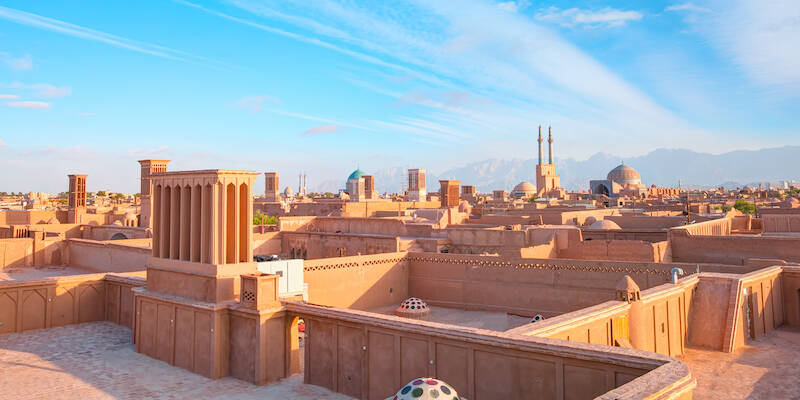
Day 12 – Yazd City Tour
Yazd is a unique desert city known for its adapted architecture, designed to cope with the hot and arid climate. Famous as the “City of Windcatchers,” Yazd showcases ingenious natural ventilation systems that keep homes cool during scorching summer days.
Your city tour begins with a visit to the Zoroastrian Fire Temple, a sacred site where the eternal fire has been burning since approximately 470 AD. Yazd is home to one of the largest Zoroastrian communities in Iran, making this visit a fascinating insight into their culture and traditions.
Next, explore Dowlat Abad Garden, one of the finest examples of a Persian garden. Built as a residential garden, it features the tallest windcatcher in Iran, ingeniously designed to cool the central pavilion. Strolling through the terraces, water channels, and flowered courtyards, you will experience the elegance and tranquility of Persian garden design.
In the afternoon, wander through Yazd’s old town, visiting the Jame Mosque and the iconic Amir Chakhmaq façade, two of the city’s architectural highlights.
No visit to Yazd is complete without exploring the Bazaar, renowned for its Termeh silk textiles. Marco Polo himself admired the city’s exquisite silk-weaving industry during his travels in 1272. Walk through the vibrant marketplace, enjoy the colors and patterns, and perhaps pick up some traditional handicrafts as souvenirs.
In the evening, experience a unique cultural activity at a Zurkhaneh, a traditional Persian gymnasium where Varzesh-e Bastani, an ancient system of athletic training for warriors, is practiced. This blend of sport, music, and ritual offers a truly authentic insight into Iranian heritage.

Day 13 – Yazd to Zein-o-Din via Saryazd and Fahraj
Start your morning with a stroll through the charming old streets of Yazd, where the windcatchers, mud-brick houses, and narrow alleys create a timeless desert atmosphere. Enjoy the quiet of the morning and take in the beauty of the city before heading out.
In the afternoon, visit Saryazd, a historic village famous for its ancient mud-brick architecture and an impressive fortress over 1,800 years old. This well-preserved castle once served as a defensive structure against invaders and offers a fascinating glimpse into the region’s past.
Next, make a stop at Fahraj, home to one of Iran’s oldest mosques. The mosque’s simplicity and historic significance provide a unique contrast to the grander Islamic architecture seen elsewhere, making it a memorable cultural stop.
In the evening, experience a truly authentic Persian journey by staying in the ancient caravanserai of Zein-o-Din. This historic rest stop on the Silk Road is one of the best-preserved caravanserais in Iran and features a rare circular layout. Today, it has been converted into a charming boutique hotel, offering a unique opportunity to sleep where travelers have rested for centuries.

Day 14 – Yazd to Persepolis (Pasargadae)
Today, you leave the desert landscapes, windcatchers, and mud-brick houses of Yazd behind and head toward the glory and history of ancient Persia. On the way, consider stopping in Abarkuh, a historic town famous for its 4,000-year-old cypress tree, one of the oldest living trees in the world. Abarkuh also features four adobe ice reservoirs, similar to the ones you saw in Meybod, showcasing ancient Persian ingenuity in water and ice preservation.
Next, visit Pasargadae, the first capital of the Achaemenid Empire, built by Cyrus the Great. The highlight here is the Tomb of Cyrus, a monumental site of great historical and cultural significance.
Afterward, continue to Persepolis, the ceremonial capital of the Achaemenid Empire, located at the foothills of Rahmat Mountain. Persepolis was mainly built under Darius I and served as a spring and summer royal residence, as well as a ceremonial center where representatives of subject states came to pay tribute to the king. The complex includes nine major structures to explore, such as:
-
Gate of All Nations
-
Apadana Staircase and Palace
-
Palace of Darius I
-
Palace of Xerxes and other Achaemenid palaces
Nearby, visit Necropolis (Naghsh-e Rostam), the necropolis of the Achaemenid dynasty, featuring four monumental tombs carved high into the cliff face. Below the tombs, you can also see remarkable Sassanid rock reliefs, reflecting Iran’s long and rich history.
You will stay overnight in a hotel near Persepolis, with the unique opportunity to enjoy a room facing Persepolis, allowing you to experience the sunset over the ruins of the Achaemenid Empire, a truly magical end to the day.

Day 15 – Persepolis to Shiraz
After breakfast, you have the option to visit Persepolis again in the morning, giving you a chance to explore areas you may have missed or simply soak in the grandeur of this ancient ceremonial capital one more time.
Soon after, you will arrive in Shiraz, a warm and welcoming city known for its friendly locals and relaxed lifestyle. You will notice the vibrant street life, with people enjoying tea, snacks, and socializing. In the evening, many families gather for picnics in any green spot they can find, creating a lively and joyful atmosphere throughout the city.
Shiraz, the capital of the Zand dynasty, is home to many historical sites from this era. You can begin your tour at Arg-e Karimkhan, located in downtown Shiraz at the beginning of Karimkhan Zand Street. Nearby, you will find the Vakil Bazaar, Vakil Hammam, and Vakil Mosque, all forming the Karimkhan Complex.
Spend your afternoon exploring this historic quarter. Wander through the bazaar, admire the architecture, and soak up the lively atmosphere. Take a break in Saray-e Moshir, a charming café where you can enjoy a herbal drink or traditional Shirazi dessert, Faloodeh. This experience will give you a perfect blend of history, culture, and local life in Shiraz.

Day 16 – Shiraz: Explore the City of Roses and Nightingales
Take a day to relax and immerse yourself in the gentle rhythm of Shiraz. This beautiful city is known for its warm, friendly people who will greet you with a smile and often strike up a conversation, giving you a true sense of Persian hospitality.
Shiraz has a rich literary and poetic heritage, earning it the nickname “City of Roses and Nightingales”, as many of Iran’s most famous poets were born here.
Morning Highlights
-
Begin your day at the Nasir al-Molk Mosque, famously known as the Pink Mosque. Its interior is adorned with thousands of pink-colored tiles, and the morning sunlight streaming through the stained-glass windows creates a magical, photogenic spectacle.
-
Visit the Tombs of Hafez and Sa’adi, two of Iran’s most celebrated poets. Walking through these sites, you can feel the profound cultural and literary legacy of Shiraz.
-
Explore the Eram Garden, a stunning example of a Persian garden. If you visit in May, the air is filled with the fragrant scent of orange blossoms, making it an unforgettable sensory experience.
Evening Highlights
-
Experience the lively social life of Shiraz locals as families gather for picnics in the city’s green spaces. You’ll see children playing and people enjoying the simple joys of life.
-
For dinner, choose from restaurants with live music and authentic Persian cuisine, offering a perfect end to your day in this poetic city.

Day 17 – Shiraz to Yasuj: Journey Through the Zagros and Qashqai Nomads
Today, you leave Shiraz and begin your journey into the stunning Zagros Mountains, a region of dramatic peaks, lush valleys, and traditional nomadic life.
Depending on the season, you may travel via Firuzabad or Sepidan, seeking encounters with the Qashqai nomads, one of Iran’s most famous tribal communities. The nomads live in small groups, typically 2–4 tents together, scattered across the mountains.
Some families still live in the traditional black goat-hair tents, while others have adopted modern canvas tents. If you are invited into a tent, you will quickly become part of their daily life:
-
Sheep and goat herding
-
Milking and dairy preparation
-
Traditional methods of making doogh, a refreshing yogurt drink, by shaking it vigorously in a sheep-skin bag or milk can
This day is not only about the mountains but also about authentic cultural immersion. You can pause along the way to meet more nomads and observe their traditional lifestyle in the heart of the Zagros.
At the end of the day, you arrive in Yasuj, a small city that serves as the main hub for the surrounding mountainous region. While Yasuj itself is modest, it offers a few comfortable hotels where you can rest after your scenic mountain journey.

Day 18 – Yasuj to Khoorang: Lakes, Bakhtiari Nomads, and Alpine Views
Today you leave Yasuj and drive along a scenic route, especially breathtaking in spring when the valleys and mountains are lush and colorful. Your first stop is near Semirom, where you can encounter Qashqai nomads tending to their herds.
Continuing the journey, you arrive at the Chogsakor Lake, a tranquil alpine lake and the first area where you will meet Bakhtiari families. Spring is a particularly magical time here, with green meadows and grazing livestock—a perfect spot for a picnic.
The Bakhtiari people often live in extended family groups. The men are easily recognizable by their distinctive black-and-white striped clothing. Many still practice traditional seasonal migration, walking long distances on foot with their herds between winter and summer pastures.
After Chogsakor, the landscape grows even more dramatic as you enter the Khoorang region. This area offers both natural beauty and cultural richness:
-
The town of Chelgerd hosts a small Iranian ski resort
-
Surrounding alpine meadows are where most Bakhtiari families pitch their summer tents
-
A perfect place for short walks, photography, and enjoying the serene mountain environment
Tonight, you will sleep in a tent camp among the mountains, enjoying simple accommodations with breathtaking views. Alternatively, you may choose to stay in a hotel in Chelgerd for more comfort.

Day 19 – Koohrang: Glaciers, Hiking, and Bakhtiari Nomads
Today you will spend a full day exploring the stunning Koohrang region, deep in the Zagros Mountains. This area is rich in natural beauty and Bakhtiari culture, offering a variety of activities depending on your interests.
Your day can include:
-
Glacier excursion: Travel up to one of the region’s small glaciers. The climb can be challenging, with a steep ascent and descent, but the views of the ice, rugged mountains, and surrounding valleys are spectacular. Perfect for adventurous travelers seeking a unique experience.
-
Hiking in the valleys: If you prefer a gentler pace, there are numerous trails through lush alpine meadows and river valleys, where you can enjoy the flora, wildlife, and dramatic mountain scenery.
-
Horse riding: For a more traditional and leisurely experience, you can explore the Bakhtiari landscapes on horseback, riding along the same routes used by nomads for centuries.
-
Encounters with Bakhtiari nomads: Along the way, you will meet local families still living in traditional tents, tending their flocks, and practicing daily routines as their ancestors did. This is a wonderful chance to observe their lifestyle and customs up close, and maybe enjoy some traditional tea or snacks with them.
In the evening, you return to your tent camp or local guesthouse, enjoying the peacefulness of the mountains and the warmth of Bakhtiari hospitality.

Day 20 – Koohrang to Isfahan via Shahr-e Kord
Today you leave the mountains and make your way back to Isfahan, the jewel of Persian culture, passing through Shahr-e Kord, the capital of Chahar Mahal-e Bakhtiari, Iran’s most scenic province.
-
Shahr-e Kord: This charming city is perched on high plains, surrounded by mountains. It’s worth stopping at Ferdowsi Tea House, one of the oldest and most traditional tea houses in Iran. Here you can enjoy a cup of Persian tea, soak in the local atmosphere, and watch the relaxed rhythm of daily life.
-
After Shahr-e Kord, it is about an hour’s drive to Isfahan, where your journey reaches its magnificent finale.
-
Isfahan: Known as “Half of the World” in Persian literature, Isfahan is a city of splendid mosques, palaces, gardens, madrasas, and bazaars. You will have enough time to explore the heart of Persian culture, interact with locals, and hunt for souvenirs, including the possibility of taking a beautiful Persian carpet home.
This day marks the culmination of an unforgettable journey, connecting the nomadic cultures of the Zagros with the historical grandeur of Iran’s central plateau.


Day 21 – Isfahan
You spend a full day exploring the magnificent city of Isfahan, strolling through boulevards lined with gardens, mosques, and palaces—a true showcase of Persian art and architecture.
-
Naghsh-e Jahan Square: Begin your tour at this iconic square, one of the largest in the world. On the eastern side is Sheikh Lotfollah Mosque, built under Shah Abbas I during the Safavid dynasty as a private mosque for the royal court. Its intricate tilework and delicate design are simply breathtaking.
-
Imam Mosque: Located on the southern side of the square, this mosque is another masterpiece of Safavid architecture, renowned for its blue-tiled dome and majestic entrance.
-
Ali Qapu Palace: Opposite Sheikh Lotfollah Mosque, explore this imperial palace, an outstanding example of Safavid art and architecture, featuring multiple terraces with stunning views over the square.
-
Qeysarie Bazaar: On the north side of the square, visit one of Isfahan’s oldest bazaars. Marvel at the painted entrance, high ceilings, and intricate architectural details, and perhaps pick up souvenirs like Persian carpets, miniature paintings, or traditional crafts.
-
Chehel Sotoun: In the afternoon, explore this elegant pavilion, built under Shah Abbas II in the middle of a landscaped park. Its beautiful paintings, reflecting pools, and garden layout make it a perfect place to relax and enjoy the serene environment.
-
Evening: Spend the evening at leisure, enjoying dinner in one of Isfahan’s many excellent local restaurants. Regardless of your hotel’s location, you’ll easily find a place serving authentic Persian cuisine in a welcoming atmosphere.
This day allows you to immerse yourself in Isfahan’s beauty, blending architecture, art, and the lively culture of one of Iran’s most famous cities.

Day 22 – Isfahan (Bridges & Jolfa Quarter)
You wake up in Isfahan with your mind still full of dreams from the previous night, filled with eslimi patterns, miniatures, and frescoes. Today, you continue to explore more of this stunning city.
-
Zayandehrood River & Historical Bridges: Isfahan is home to the largest river of the Iranian Plateau, the Zayandehrood, along which stand some of the most beautiful bridges in Iran. Out of the eleven historic bridges, you will visit two highlights:
-
Allahverdikhan Bridge (Si-o Se Pol): The largest and most iconic bridge, with its 33 arches and stunning architectural rhythm.
-
Khaju Bridge: Praised by Arthur Pope and Jean Chardin as "the culminating monument of Persian bridge architecture," Khaju Bridge is admired for its perfect harmony of utility, beauty, and recreation.
-
-
Armenian Quarter (Jolfa): Next, explore the vibrant Jolfa district, home to Isfahan’s Armenian community. Here, you can visit the magnificent Vank Cathedral and its museum, a testament to the fusion of Persian and Armenian art.
-
Strolling in Jolfa: While wandering the alleys, you’ll notice the aroma of freshly brewed coffee from numerous coffee bars—perfect for a relaxing break. Jolfa is a lively area in the evening, with street food, cafes, and restaurants attracting locals and visitors alike. It’s a perfect place to soak up the atmosphere and enjoy a casual dinner.
This day allows you to experience Isfahan beyond its squares and mosques, combining architectural masterpieces, riverside beauty, and the charm of the city’s multicultural quarter.
Day 23 – Departure from Isfahan
Your journey through Iran comes to an end. Based on your flight schedule, an escorted transfer will take you from your hotel to the airport. Wishing you a safe flight and wonderful memories of your Iranian adventure!